
You aren’t in Kansas anymore.
With directorial credits on his resume like The Terminator, Aliens, T2, and The Abyss, James Cameron‘s place in cinematic lore is secured. Arguably his most ambitious project, however, is the ongoing Avatar franchise, which has seen two movies released already with three more reportedly on their way over the next several years. While it has never connected with us in the same way his earlier work has, there’s no denying Cameron’s flair for world building with the awe-inspiring fictional planet of Pandora.
Given that the first film came out in 2009, it’s more than a little surprising that the property hasn’t been leveraged to create video games with James Cameron’s Avatar: The Game being the lone console release. With the film’s first sequel (The Way of Water) finally coming out, gamers are getting their chance to enter Cameron’s universe with Ubisoft’s open-world title, Avatar: Frontiers of Pandora.
In terms of creating a first-person experience that makes you feel like you’re a 10-foot-tall, uber-athletic Na’vi, Frontiers of Pandora does a decent job. Moving through the world on foot creates an exhilarating sense of speed, and you’ll unlock additional abilities as you progress that allow you to do things like double jump to move vertically or punch through the cockpit of human mechs, leaning into the idea that you’re a powerful force of nature and not just a tall person. Shooting is solid, though after recently sinking a bunch of hours into Modern Warfare 3 it doesn’t feel nearly as crisp or varied. The bow at least feels viable and satisfying, which is important.
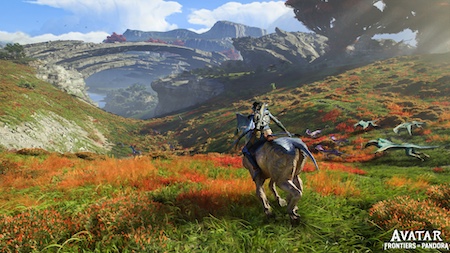
Graphics is where the game shines the brightest. The world of James Cameron is effectively brought to life here, both with flora and animals you’ll recognize from the films, but also new creations, which manage to feel like natural extensions of Pandora. It’s easily one of the best looking games of 2023, which is even more impressive for a first-person title. It’s very cool to see the natural world react to your presence, and once you unlock the ability to fly, the massive map opens up — though unfortunately flight lacks the feeling of speed you get on the ground.
On the downside, enemy variety is a bit lacking and the human bases end up feeling very much the same both in terms of presentation and objective. Voice acting is fine, but the game falls victim to a lack of engaging characters. It doesn’t help that the Na’vi tend to have similar names and are difficult to distinguish from one another. On the human side, the villains don’t get enough screen time to build them up into anything memorable. That combination of things conspires to make the world less interesting than it could’ve been, which is unfortunate.
Frontiers of Pandora places you in the role of a Na’vi orphan that is raised by the RDA (Resources Development Administration) as part of an outreach program to bridge the gap between humans and the Na’vi under the supervision of John Mercer, who soon proves to not have the children’s best interests at heart. The program is abruptly scrapped when Jake Sully forces the RDA to evacuate, causing Mercer to order the students to be killed. Instead, they’re able to escape into a cryogenic sleep.
Sixteen years later, the students are awakened to find the RDA has returned to Pandora. After escaping another execution attempt, they link up with a group of resistance fighters with the goal of driving the RDA back. That sets the stage for the major gameplay elements as you’ll be tasked with enlisting the aid of reticent clans in the fight against the RDA. It’s a decent enough story, albeit one that comes up short in some key areas, mostly relating to the development of its main villains, who are given little screen time, and an anticlimactic finish.
The structure and feel of the game make it easy to draw the comparison between Frontiers of Pandora and Ubisoft’s long-running FPS series Far Cry, minus the off-beat cast of characters. Pretty early on you’re free to advance as you see fit in terms of exploration, tackling side quests, or following the main story arc. There is a leveling system in place, relating to a combination of your gear and development of your skill tree, that offers guidance, but as long as you’re within reasonable range of the suggested level you should be fine.
As mentioned, there is a repetitiveness at work here that undercuts what might’ve been. The gun play is fine, but coming on the heels of playing Modern Warfare 3 it lacked the punch and variety — it is also one area where Avatar feels inferior to Far Cry, which always had a healthy selection of weapons, whereas here it’s essentially assault rifle, shotgun, and bow. You’re also lightly armoured (to be kind), so you take damage quickly. That can lead to frustrations during those encounters when enemies seem to spawn out of thin air.
OVERALL (3.75/5)
Avatar: Frontiers of Pandora is a fine game. It’s on the short list for the most visually impressive games of 2023. Flying is fun. Combat is solid. However, it never quite reaches its potential because of lacklustre villains and repetitive mission structures. Even still, there’s plenty here to appeal to both Avatar fans and FPS enthusiasts.